Stella attends Macalester College, where she is working toward a Bachelor of Arts with a major in biology. She is interested in ecology and plant biology. As an REU with EVOME, her research is focused on willow physiology and growth.
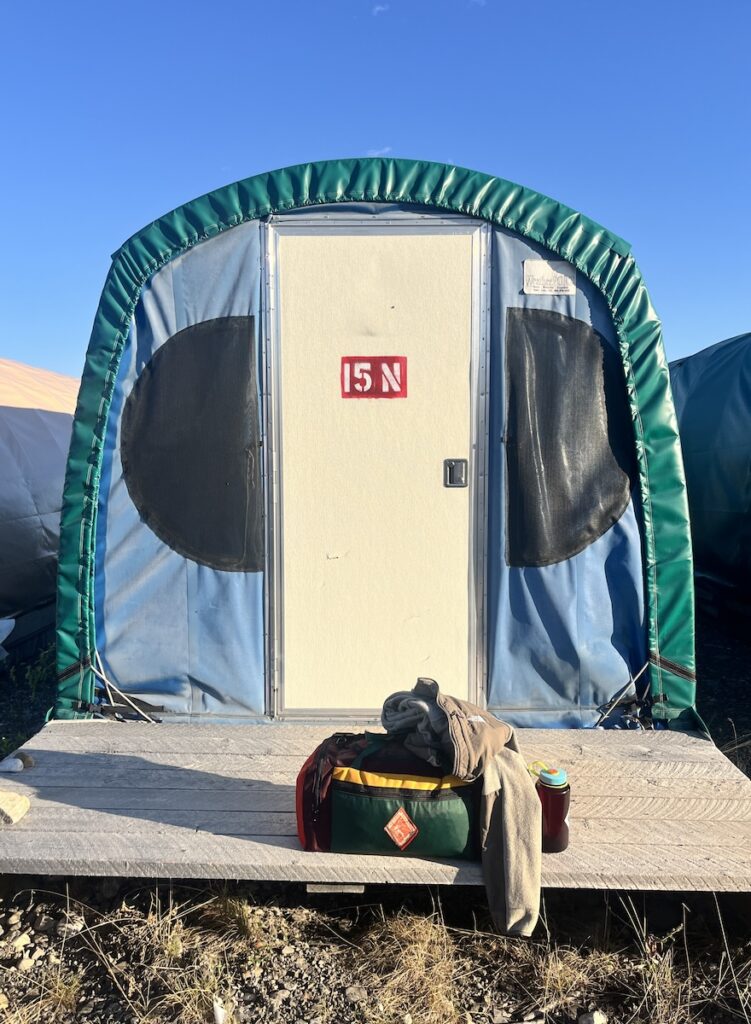
I arrived at Toolik Field Station after a long, bumpy 10 hour ride up Alaska’s Dalton Highway. Locally referred to as the “Haul Road,” this 414 mile stretch of gravel was our gateway to Arctic research in the northern Alaska wilderness. For almost everyone at the field station, this travel ritual is the same. We drive up together, chat, listen to music, and share our excitement for the field season. Some of us were here last year; however, like me, many are new. This summer would be my first in Alaska. Once at the field station, I looked carefully for my weatherport, 15 N. I dropped my duffle at the door and gazed at the heavy duty tent I would be staying in for the next 2 months.

As I stood in front of my weatherport, I could feel a nervous chill. “This is reality,” I told myself. I am really here, 158 miles north of the Arctic Circle. I took a quick photo to send to my family and went inside. That my new home was a simple plastic tent with a wooden floor, a cot, and a bare lightbulb surrounded by the vast Arctic wilderness made me realize just how far from civilization I was. In a way, the simplicity of my new living quarters helped me to quickly establish a new routine.
Before I knew it, my weatherport started to feel like home. This sentiment began just a week in when I added a personal touch to the porch outside—an antler I found shed by a caribou on James Dalton Mountain. This hike was one of my favorites. With 4000 feet of elevation gain, a long section of tundra slog, and some sketchier sections of loose rock, it was certainly intense. Nonetheless, it was a nice break from our typical fieldwork days and a good opportunity to connect with folks at Toolik working on other projects.
These outings offered a great excuse to connect with other researchers, and with each adventure I brought back a new memento to decorate my deck. Rocks, fern and coral fossils, and even a few pieces of ‘jade’ from Jade Mountain accumulated on my porch. Imagine my disappointment when, after lugging these rocks back from the top of the nearby mountain, I discovered my precious jade was actually just a common rock known as chert. The sentimental value remained intact, though.

Comradery among my research team was strong and helped develop a sense of community. The intensity of our remote fieldwork presented us with a number of challenging days. From cutting and hauling willows in thick mosquitoes and blazing sun to huddling over malfunctioning equipment in pouring rain, we found ways to bring levity to any situation. The games we invented and the small moments of fun had an outsized impact on the positive work climate at Toolik.
As our sense of community deepened, new friends began leaving similar gifts on my doorstep. Bone fragments and interesting rocks they brought from the field augmented my micro-natural history museum. I was thrilled when I noticed my weatherport neighbors also starting porch collections of their own.

Though I had arrived with no intention of customizing this little tent, I noticed my connection to Toolik deepening with every personal touch I added. As the season drew to a close, the thought of disassembling my collection was bittersweet. The items on my deck were more than trophies from my adventures in the field. They were tangible reminders of my connections to this unique community and of the work I had undertaken to develop this sense of place. While the research brought us together, the sense of community we developed extends far beyond an individual project or single summer. Although the specifics of the research may change every year, the tradition of wayfaring will remain the same.