
What’s Genomics Krewe been up to?
As an REU for the EVOME Willow Genomics krewe (a playful adoption of the Mardi Gras term), I assist in surveying genetic variation of the Arctic willow, Salix alaxensis, across the vast temperature gradient of the Brooks Range while staying at Toolik Field Station. We are interested in the temperature gradient because it can tell us how willows might react to increasing temperatures due to rapid climate change in the Arctic. We focus on a single common willow species to simplify the genomics.
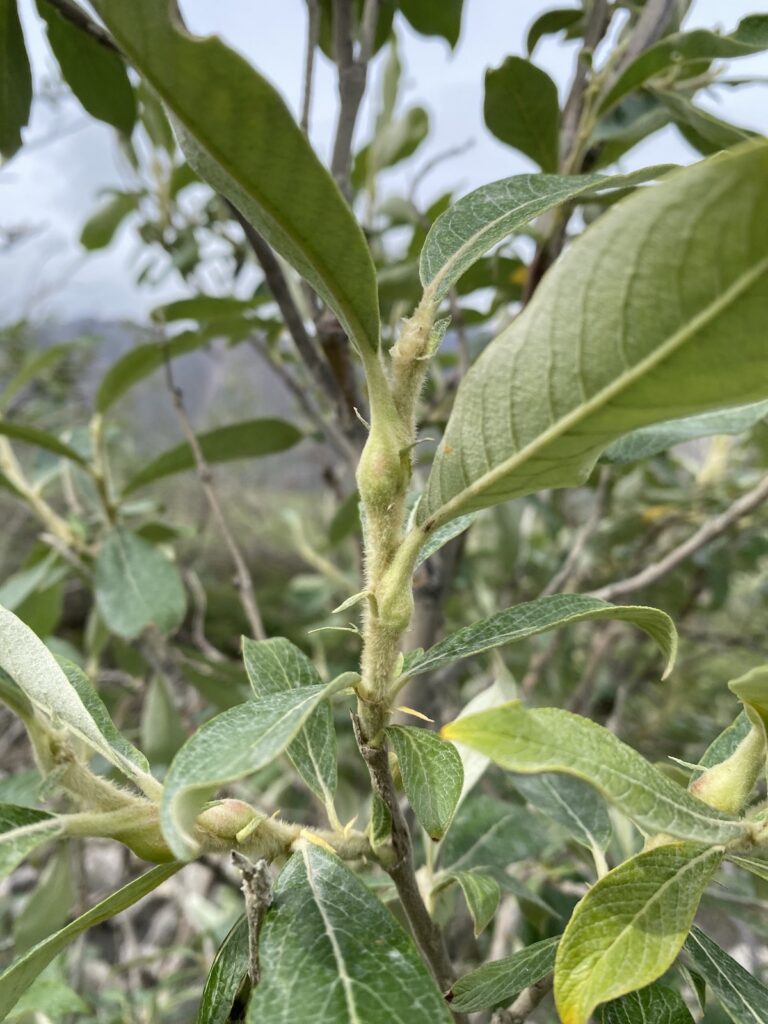
To survey the genomics of willows, first you need a willow genome. To get a willow genome, you need a willow. So, my krewe and I went to EVOME sites located along the Dalton Highway north and south of the Brooks Mountain Range. At each site, our goal was to obtain a teabag (yes, an actual teabag) full of Salix alaxensis leaves, colloquially referred to as the feltleaf willow, from 40 willows to get a representative sampling of the population at each site. But it isn’t always so easy.
As we found out, the hard part was getting to the site. Though we had the correct coordinates, we would unknowingly drive past the needed turn, and our pin on the map would hop right by the coordinates at 50 miles per hour. Then the truck would turn around, and sometimes we’d find the right turn off, but at a few sites we would drive right by once again. It’s especially embarrassing when you pass the same construction flagger three times. Eventually, though, we found the right turnoff and collected our samples.

We sampled leaves because the leaf contains the most easily obtainable DNA for extractions. With our collected samples, we will sequence the genomes of the roughly 440 individuals across the range. Then, my krewe will analyze the genomes to compare genetic variation between willow populations.
Willow teams unite!
Genomics krewe isn’t the only one studying willows for the EVOME project. Another, called Willow Ecology, is working to characterize the growth patterns of willows across the temperature gradient of the Brooks Range. Like the Genomics krewe, they are going to sites along the Dalton and sampling willows like Salix alaxensis and Salix pulchra. Their sampling includes lopping willow branches, then slowly plucking the leaves and carefully cutting the branches at each year’s growth scar so that mass and length of each piece can painstakingly be measured to characterize each year’s growth rate. In my last week at Toolik, I helped chop up many willows with the Ecology krewe.
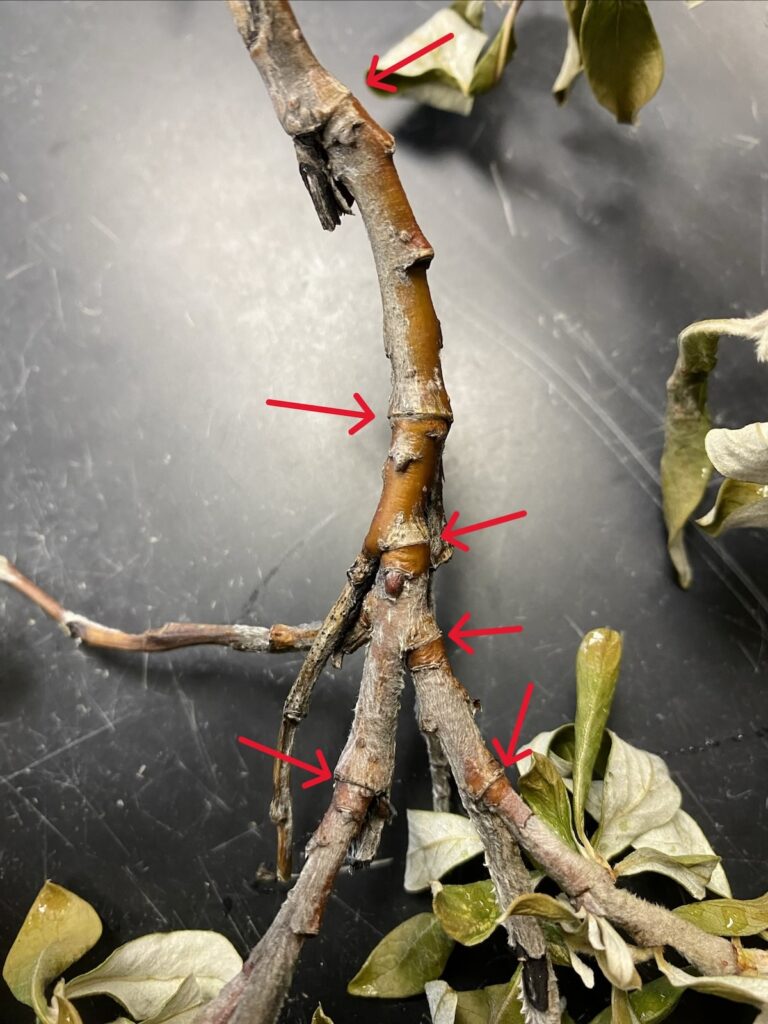
Seems redundant, you might think. Two krewes studying variation of willows across the gradient? How different could their conclusions possibly be? Well, while Ecology krewe is investigating morphological variation, Genomics krewe is studying genetic variation. The morphology investigation determines how the willows physically vary across the gradient, and the genomic investigation determines the cause of this variation: genetic or environmental.
It all comes together in the common garden…
These concepts coalesce in Genomics krewe’s common garden. A common garden brings populations from different environments together to a single environment where each population’s traits can be measured and analyzed. This method isolates phenotypic differences caused by genetics. By keeping the environment the same, any differences between populations in the common garden are evidence of genetic adaptations. By combining genomic and morphological analysis, we hope our common garden will reveal temperature adaptations of Salix alaxensis across the temperature gradient. This can indicate how drastic Salix alaxensis populations may change as the Arctic warms due to climate change.
We can trace each individual in the common garden back to its parent tree and assemble and annotate its genome, allowing us to identify and compare any genetic differences between populations. These genetic differences will then be correlated to morphological measurements, like branch length and flowering time, that characterize each individual’s growth rate. If significant growth rate correlations are found among populations in the common garden, we can identify which genes may influence temperature-adaptive traits by comparing the genetic differences we find in individuals between populations.

Revelations?
The Willow Genomic and Ecology krewe’s investigations bring insight into each other’s conclusions that neither krewe could reach alone. I realized this while cutting up willows for Ecology krewe’s analysis. I reflected back on my experience sampling up and down the Brooks, knowing Willow Ecology had done the same for the branches I was cutting up, and delighted at the idea that these different approaches to analyzing Arctic willows complement each other so well. By using some of Ecology krewe’s methodology in our own common garden, we can write a complete story about temperature adaptations in the Arctic willow Salix alaxensis. Genomics krewe planted the common garden this year, so measurement collections will begin in spring 2027!