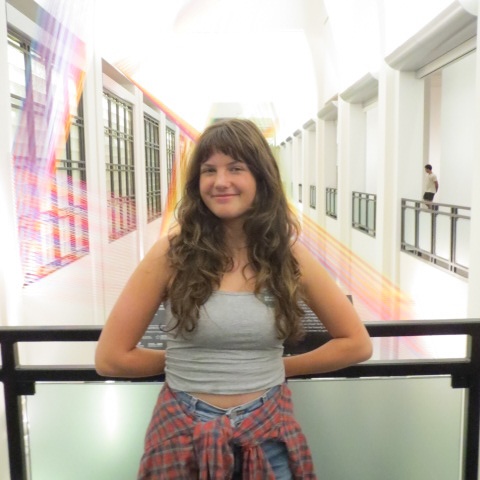
Kelly Slade (she/her) is a sophomore biology and english major at the University of Alabama. She works in the Lozier Molecular Ecology Lab as an undergraduate researcher and has been helping Dr. Jeffrey Lozier and Ph.D. student Maddy Frey with their work on EVOME since last fall. After completing her undergraduate degree, she hopes to pursue a Ph.D. in Ecology and Evolutionary Biology.
My Foray into Insect Research
The presence of beetles is one of those facts of life that I’ve always taken for granted. Whether it was the garden ladybugs or the fireflies in my parents’ front lawn – for most of my life I never gave them a second thought. Today, this couldn’t be further from the truth.
I’ve always known I wanted to go into ecology and wildlife sciences and– at the urging of a fellow STEM student at the University of Alabama– one of my first priorities when beginning my freshman year of college last fall was to get involved in an on-campus lab. After researching and reaching out to several, I was offered a job sorting insects for the Lozier Molecular Ecology Lab and, by extension, the EVOME project. Being, in all honesty, a bit terrified of missing my window to get involved on campus, I accepted the offer without much thought about entomology as a potential path. Thus began my only slightly intentional foray into insect research.
Dr. Lozier gave me some books on insects and beetles and I started doing research alongside work in the lab: turns out beetles are essential– shocking, I know. Not only are they the most abundant order in the animal kingdom, they are also the most diverse. Since they respond rapidly to changes in their environments, they also serve as important bioindicators. Thus, in ecosystems as sensitive to climate change as those found in the Arctic, an understanding of beetle populations is vital to conservation efforts. The Evolving Meta-Ecosystems project (EVOME), as I quickly learned, aims in part to tackle this exact issue. By studying ecosystems in various climate stressed areas such as the Arctic, particularly the Alaskan Brooks Range, EVOME works to gain a better understanding of how ecosystems adapt to climate change. By integrating various teams focusing on the environment, the organisms involved, and their genomics a broader picture is drawn of the ecosystem as a whole.
This summer, I took the skills and data I gained from my work on the EVOME project during the school year and began to look at how I could further explore the population dynamics of beetles in the Brooks Range and surrounding areas. I did this by collecting data on several different aspects of our samples from different sites and dates including the number of individuals, the bulk mass, and the bulk area. The number of individuals were counted and sorted into insect order, the individuals sorted as Coleoptera (beetles) were then taken for more imaging and weighing to deduce their area and mass.
Since the majority (as in essentially the entirety) of the people in the Lozier Lab were either away from campus for the summer or up at the Toolik Field Station in Alaska with EVOME, I spent the vast majority of my time alone in the lab. In combination with the eerily empty nature of many college campuses over the summer, I spent a good bit of time isolated with the beetles. While I know this might sound a bit sad to some of you- although I personally find dead beetles to be riveting company- I found it strangely beneficial to learn how to be self-sufficient and independent.
College has taught me, more than anything, that 19 is a weird age. One minute you think you’re a fully-realized adult and the next you’re calling your mom because you forgot your social security number. Being alone a lot this summer really forced me to learn how to juggle my responsibilities by having to keep track of large datasets whilst also remembering to eat enough and get good exercise (bending over a microscope for 6 hours without stretching is not a good idea). Being alone is uncomfortable for us sometimes, but knowing that you have the ability to be is one of the most freeing things.
In addition to teaching me such a valuable lesson, my time alone allowed me to really hone in on my tasks and complete a huge chunk of our sorting work. Overall, I sorted a total of 22,785 insects – almost half of all the insects counted in our coarse samples–not too shabby for an amateur!
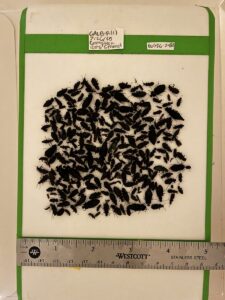
Left: A picture taken for the bulk area analysis of beetles at one site. Photo: Kelly Slade.
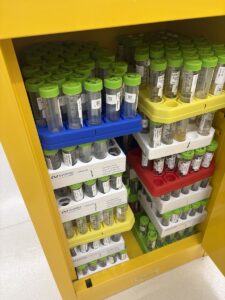
Right: A flammables cabinet filled to the brim with sorted insects. Photo: Dr. Jeff Lozier.
My hope in gathering all this information was to see whether they correlated with one another and what that might tell us about the beetles. In addition, I also took images of individual beetles to assess the possibility of adding individual mass and morphological measurements to our other data. While the time-consuming nature of the process prevented me from collecting very much information, it turned out to be useful in that I was able to use this data to practice plotting graphs in the statistical software program R, a very important skill in analyzing biological datasets. For instance, by plotting the mass of individuals by the length of their elytra (protective wing covers), I observed a direct positive correlation.
My work this summer has taught me a great deal about an order of species that I knew so little about beforehand. From showy and iridescent Carabids to small and unassuming Stapholinids, beetles show an immense level of diversity even within small regions. Everything from the color of their elytra, to the small grooves and indents on their exoskeletons– there are so many fascinating details you might notice if you only stop to look.
While this journey into entomology may have started as an introductory undergraduate experience, my findings this summer have only sparked deeper questions I seek to answer: Why is there a greater biomass of insects at higher latitudes of the Brooks Range? Are there other trends in species and trait dispersal that I have not noticed? It is with this burning curiosity that I hope to delve further this coming school year into analyzing new data with DNA barcoding and biogeographical analysis.
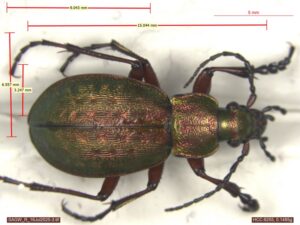
Left: An individual image with measurements of one Carabus truncaticollis. Photo: Kelly Slade.
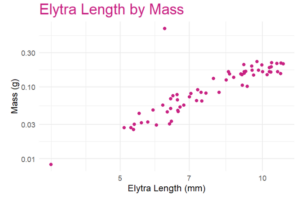
Right: A graph plotting elytra length by mass for individuals, created using R. Photo: Kelly Slade.
The Responsibilities of a Researcher
With this summer opportunity, I have glimpsed into the laboratory side of research ecology, an area of meticulous attention to detail! While my work this summer allowed me to continue to hone my skills in the lab, it also forced me to learn a lot about managing huge numbers of samples and data, and learning to keep things organized; we have hundreds of tubes of bugs to keep track of! I have also been thinking about what my work really means to me and the impact I want to make on the world. It is because of this that I began to think a lot about what my responsibilities are as a researcher and – as we enter the age of generative AI – what the advancement of AI tools means for environmental research. Working this summer I noticed how AI stood as a very convenient way to cut down working time and make tasks more manageable. This particularly helped in extracting the body size of beetles in bulk images taken of beetle samples by automating the – typically very time-consuming – process. While the efficiency of this cannot be understated, I can’t help but have reservations in light of recent findings of the environmental impacts of these technologies. AI can be an incredibly useful tool for some specific tasks and is getting better every day. These facts I will not deny. All I urge is that we approach this tool with the same level of ecoconsciousness and humanitarianism that we approach countless other contentious technologies. Scientific curiosity and innovation are wonderful and defining traits of our species. I only mean to remind you that the same curiosity that discovered the life-saving drug that is penicillin also created the atomic bomb.