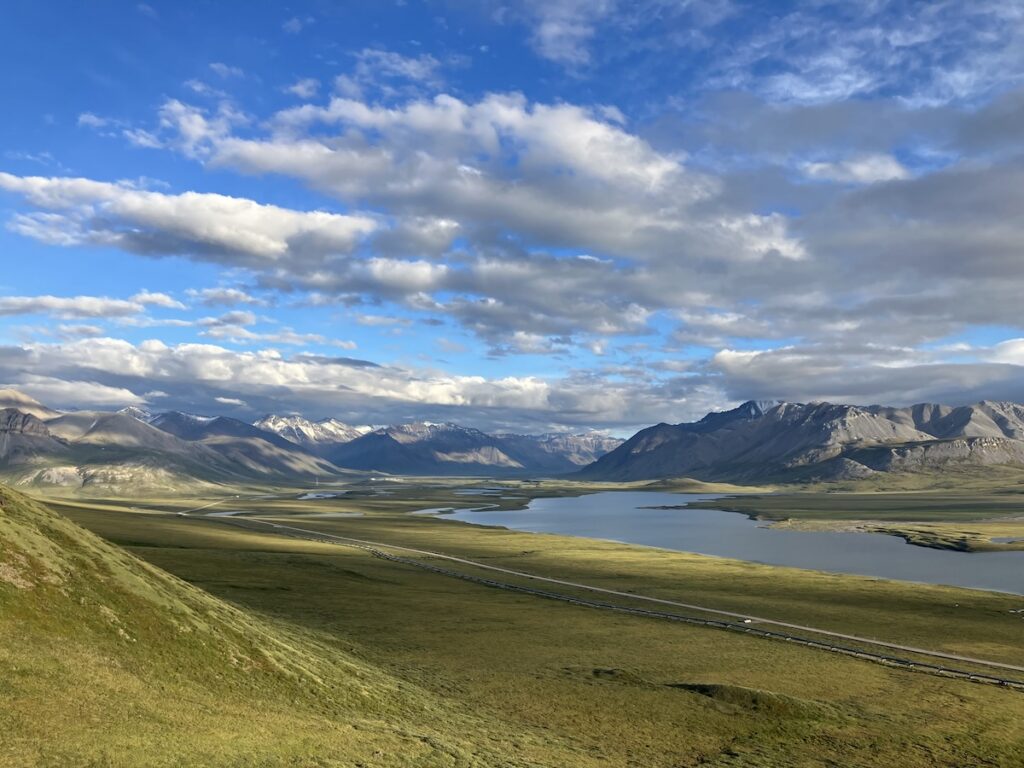
I am an undergraduate in Biological Sciences at the University of Alaska Fairbanks, focusing on arctic ecology. This summer I was working with Arctic grayling in northern Alaskan streams with the EvoME fish team.
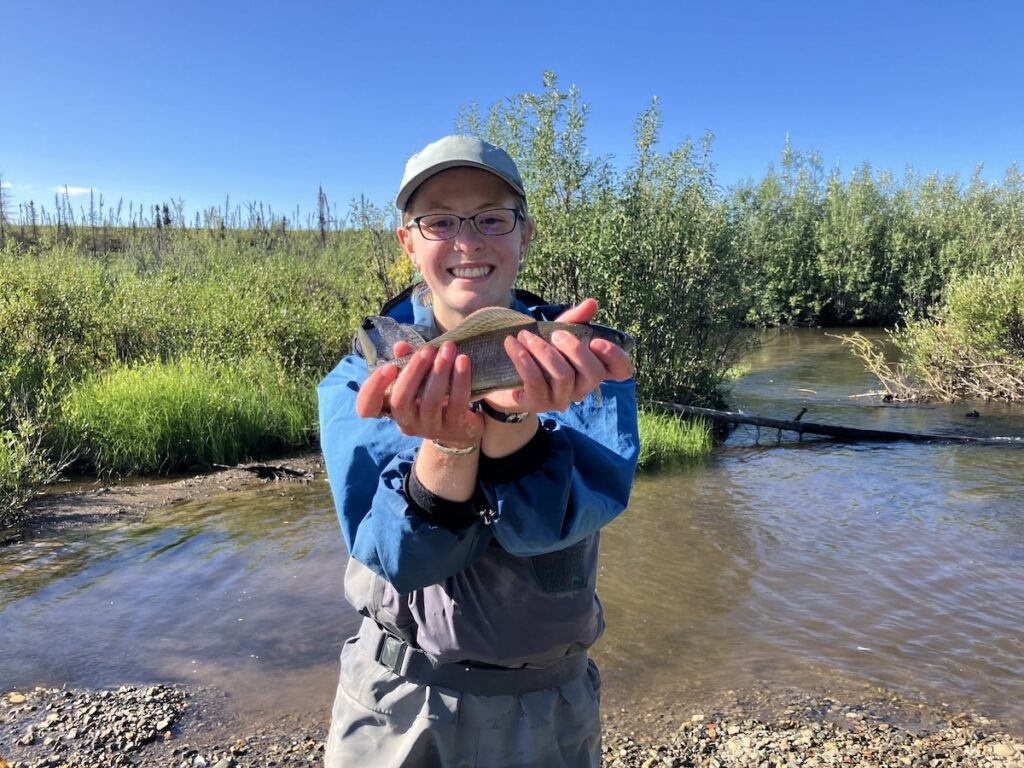
We started the summer in the Alaskan arctic with ambitious goals, planning to catch at least eight Arctic grayling (Thymallus arcticus) every day so fast that we could then run the hours-long physiological measurements with plenty of time to spare for dinner. By the end of the season we would realize just how unrealistic these goals were. This was the first of many lessons I learned this summer about the realities of fieldwork as an undergrad research assistant.
The stream we stopped at on my first day of fieldwork was aptly named Fish Creek. To get to the creek, we hiked through some closely grown trees before finding ourselves in a beautiful open field, carpeted in moss and brightly colored lichen, speckled with blueberry bushes that I knew would be covered in berries later in the summer. Here and there were lone spruce trees, short and knotted from acidic soil and the high latitude. We hadn’t even made it to the fish, and I was already enthralled. The creek was hidden behind another line of trees at the far end of the mossy field, and we heard it long before we saw it. Winding its way underneath overhanging willows and alder, the water is clear, fast, and cold, with deep pools that promised many fish.
Despite the auspicious name, our certainty in our catching skills quickly faded. We fly fish for Arctic grayling in part because it is the least stressful way to capture a fish and in part because it is supposed to be easy. But it took us hours to land our eight fish at Fish Creek.
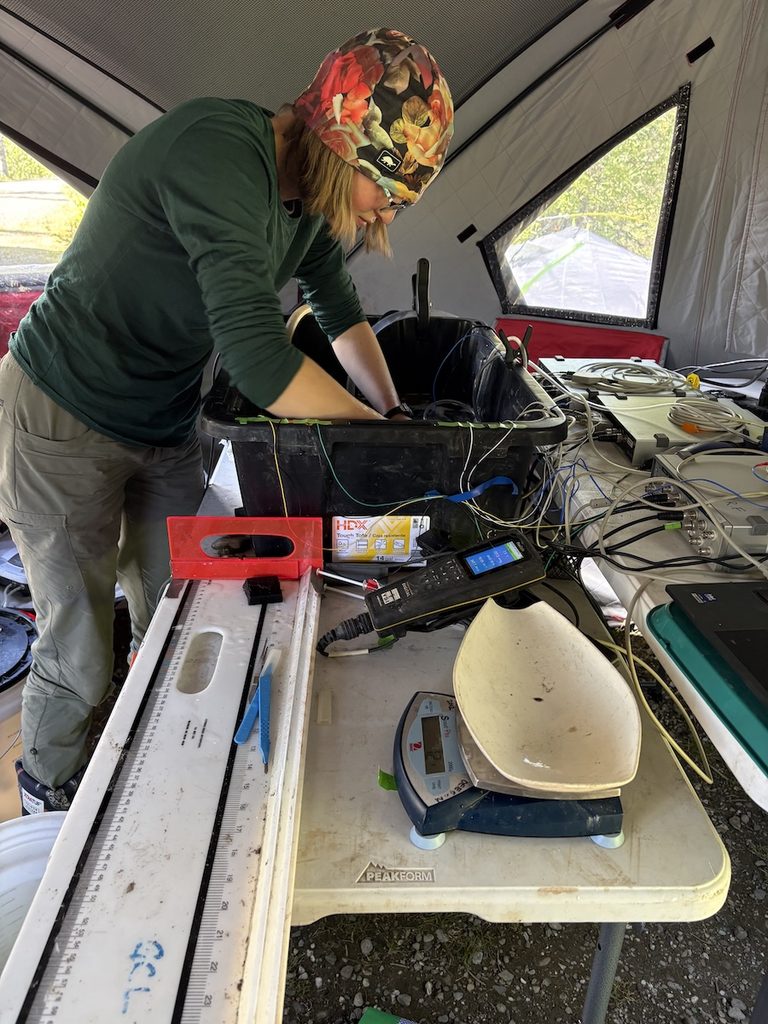
We got back to the truck with our fish to run the first 3-hour test (heart rate) significantly later than planned. The grayling were paddling peacefully in their five-gallon buckets, heedless of us running around them, setting up the tent and the tentacles of wires and electrodes that we would use to measure their heart rates. Soon enough everything was set to go. Standing outside, ready to start the generator, we were feeling hopeful again.
Disaster strikes
The generator roared to life, we turned on the power strips… and were immediately surprised by a loud pop and a puff of smoke from one of the cords. One cord in the ordered nest of power strips was broken, with the plug almost completely separated from the cord. It was the water pump that would run water through the fish’s gills to keep them alive under their anaesthesia. The test would not work without it, and we didn’t have a replacement. Unbeknownst to them, four of our fish had just been spared from having their heart rates measured.
This was the second lesson I learned on my first day of fieldwork. If you have everything planned out perfectly, things will definitely go wrong. You have to be able to think creatively, keep up morale, and find a way to make it work anyway.
We pivoted to the second test we could run on the fish, critical thermal maximum, or in shorthand, CTmax. This is a widely used thermal tolerance test to determine the temperature at which the fish can no longer hold themselves in a swimming position (this temperature is CTmax). At this point, they are removed to recover in cool water. This test entails a lot of sitting around, slowly heating up a cooler full of water at 0.1oC per minute and monitoring the fish as their body temperatures increase with the water temperature. We sit in silence for a while, watching the fish swim back and forth. Despite the huge disappointment of being unable to collect half of our data, we couldn’t be sad for too long. We knew how to get a replacement part and a spare, though it would be a while before it could reach us this far north. In the meantime, we would have to make do with what we had.
Reflections
Though this was one of the crazier days of the field season, we faced similar chaos and unexpected challenges over the summer. Despite this and other setbacks we faced throughout the field season, there was a sense of wonder that would always return to me. Yes, the importance of the data and knowing its role in a larger scientific endeavor gave meaning to our work. But that wasn’t what drew me back to work every day. It was being outside, standing in the water, waiting for the fish to bite, and feeling that even for just one moment, I belonged in this place, with the dwarf birch and the rolling hills at the edge of the Brooks Range. It feels a bit silly, and certainly not scientific. These numbers are important, and can help us understand how this landscape works, and how it may fare under a changing climate. But when it comes down to it, I’m not here because I like numbers. I’m here because I care about fish, streams, willows, and all the beauty of this landscape. And that makes all the troubleshooting and problem-solving worth it.