
Ellis Timmer is a junior biology and geography major at the University of Alabama. As an REU for EVOME’s bug team, Ellis is studying how arthropod communities differ across the latitudinal gradient. She assists with food web and subsidy characterization through the use of stable isotopes, and with basal resource and aquatic insect collections.
I grew up hating bugs. The people that worked with me this summer probably wouldn’t have thought this after seeing me constantly look at bugs in the field, or keep a special stink bug in a vial in the lab, but I used to not like them at all. The expansive concrete sidewalks and lack of dirt in New York City led those of us who call it home to associate bugs as pests and feel the need to get rid of them. In fact, after a previous summer of soil research in New Mexico, which involved looking at bug communities, I told myself I’d never work with bugs again. Yet, I found myself applying to EvoME’s Bug Team in an effort to get involved with stream research, and I ended up working with bugs once more.

My journey to Toolik Field Station north of the Brooks Range in the Alaskan Arctic where I would spend the next 8 weeks of my summer, was nerve racking to say the least. I constantly asked myself what I was doing travelling to a place so much further north than I’d ever been and wondering if I would even like it. But, the rave reviews from those who’d been to Toolik before and my desire to see the Arctic won me over, and I quickly found myself wearing Xtratuffs and feeling like I fit in with those who had been at Toolik many years.
On the Bug Team, we aimed to get a holistic sample of 15 sites’ bug communities every 2 weeks. This involved setting up sticky traps at several distances from the stream to get a sense of what flying insects were present and how far they were travelling as they emerged from the stream as adults. We collected pitfall traps, in which a cup is placed below the ground so that ground-dwelling arthropods can fall in, to assess the terrestrial arthropod communities that live in the stream’s riparian zones, as well as in the uplands 400m from the stream. Finally, we collected surber samples in the stream, which are achieved by mucking up everything within a one foot square, and catching the aquatic bugs that are dislodged and flow downstream into the net. By getting a holistic understanding of the bug community, we are finding out what bugs are available when, for consumers like birds and fish.
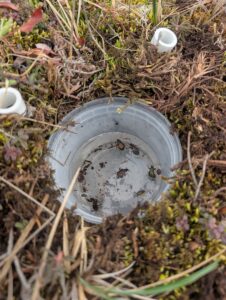
Pitfall trap at Toolik River (TOOL). Photo: Ellis Timmer.
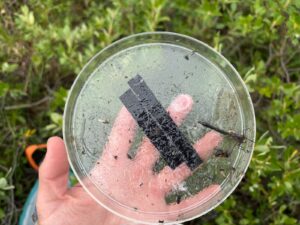
A sticky trap with lots of bugs. Photo: Maddy Frey.
The day-to-day work to achieve this isn’t as clean-cut as the description sounds. Hauling heavy buckets full of preservative and bug samples across the tundra is, surprisingly, not fun. But, we often found ways to make the days more enjoyable. When flooding or the lingering presence of ice prevented us from working, it once prompted a spontaneous hike to the Galbraith aufeis where I saw blue ice that was taller than me for the first time in my life. To keep the bears away we sang “Let Her Cry” by Hootie and the Blowfish on our hikes to field sites. The song then became Bug Team’s tradition, and was sung many times at our weekly Toolik karaoke nights. During trips back from our field sites in our lovingly named trucks (Barbtruck, Gorbuduc, and Belinus) we’d talk about evening plans as we killed the lingering mosquitoes inside the truck by hitting them against the windows. Some of us were excited for that night’s edition of our Love Island UK watch parties, or extended stays in the sauna followed by cold plunges off the dock into Toolik Lake.
I’ve heard others refer to our time at Toolik as “type two fun”. When you are covered from head-to-toe in waders and long-sleeve sweatshirts, your sweaty hands overlaid with nitrile gloves to protect from the mosquitos ready to bite them, drinking sips of water through the net of your bug shirt, doing anything you can to keep the swarm of mosquitoes from finding their way in, things seem completely terrible. After all, having numb fingers and flooded boots from working (and sometimes falling) in streams with water temperatures just above freezing is nobody’s idea of “fun”. But, despite all of that, you get back from a day in the field and you realize that everything is ok, and even find yourself excited to do it again tomorrow.

As I continue to work with the bugs back at the University of Alabama, I fondly remember the people and experiences that shaped my Toolik summer. The research may have brought us to Toolik, but the camaraderie of being the only people in a 100 mile radius is what brought us together and keeps people coming back year after year to endure the harsh conditions so far from home. Currently, I still can’t decide if I like working with bugs now, or if I just liked my time in the Arctic, but I certainly have plenty of time ahead of me to figure that out.
